
Small-Batch Sauerkraut with Caraway
A crisp, tangy small-batch sauerkraut fermented with caraway for a classic deli-style aroma. This recipe is sized for a 1-quart jar and uses salt-by-weight for repeatable results.
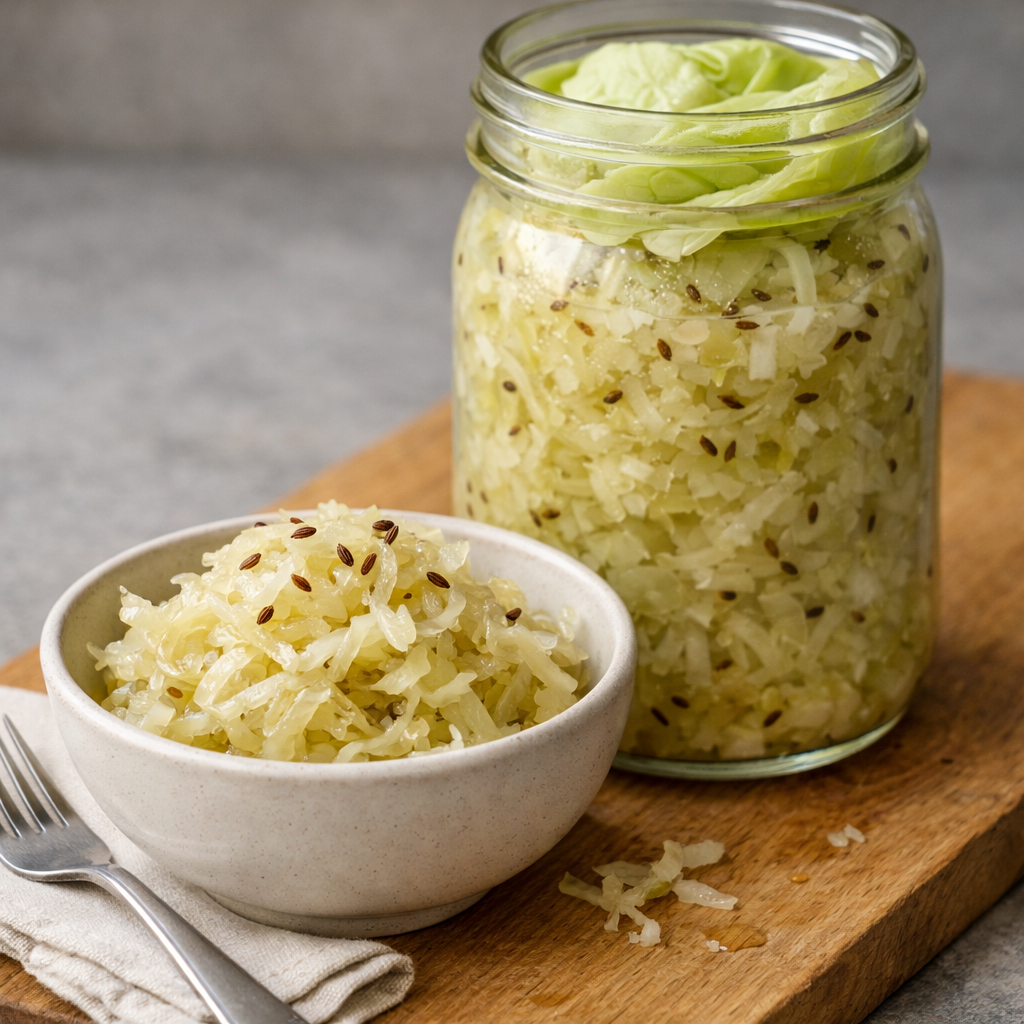

Sauerkraut is a controlled microbial succession: salt suppresses spoilage organisms while lactic acid bacteria convert cabbage sugars into lactic acid. As acidity rises, the environment becomes self-preserving—provided the cabbage stays submerged and oxygen stays out. This small-batch approach makes it easy to observe brine formation, bubbling, and aroma changes day by day.
Total Time
240 hr 20 min
Prep Time
20 min
Servings
10
Ingredients
Vegetables & Seasoning
- •800 g green cabbage (about 1 small head), outer leaves removed and reserved, cored and thinly sliced
- •16 g fine sea salt (2% of cabbage weight; see notes in instructions for scaling)
- •1 1/2 tsp caraway seeds, lightly crushed
- •Optional: 1 small garlic clove, thinly sliced
Equipment (recommended)
- •1 clean 1-quart (1 L) wide-mouth jar
- •Fermentation weight or a small water-filled jar that fits inside
- •Airlock lid or a standard lid (to be burped) plus a tray to catch overflow
- •Kitchen scale
Instructions
- 1
Sanitize and set up: Wash jar, lid, and any weights in hot soapy water, rinse well, and let air-dry. Reserve 1–2 whole cabbage leaves to use as a “cap” to help keep shreds submerged.
- 2
Weigh and salt precisely: Weigh the sliced cabbage in a large bowl. Calculate salt at 2% of cabbage weight (grams of cabbage × 0.02 = grams of salt). Add the measured salt to the cabbage and toss to distribute.
- 3
Massage to draw brine: Using clean hands, massage and squeeze the cabbage for 5–10 minutes until it looks glossy and releases enough liquid that a small pool of brine collects in the bowl. Let rest 10 minutes, then massage again briefly.
- 4
Season: Add caraway (and optional garlic) and mix thoroughly.
- 5
Pack the jar tightly: Transfer cabbage to the jar a handful at a time, pressing firmly with your fist or a tamper to remove air pockets. Pour in any brine from the bowl. Leave 2–3 cm (about 1 inch) headspace.
- 6
Submerge: Fold the reserved cabbage leaf and press it down on top of the shredded cabbage to act as a cap. Add a fermentation weight to keep everything below the brine line. The cabbage should be fully submerged; if needed, wait 30–60 minutes for more brine to rise. If still low, top up with 2% salt brine (20 g salt dissolved in 1 L water) just to cover.
- 7
Ferment at cool room temperature: Place the jar on a tray (to catch overflow) and cover with an airlock lid, or use a standard lid set loosely. Ferment at 18–22°C (65–72°F) for 7–14 days.
- 8
Manage gas and monitor: If using a standard lid, “burp” once daily for the first week by briefly loosening the lid to release CO2, then re-tighten. Check that cabbage remains submerged; skim any harmless surface yeast film if it appears, and ensure the weight stays below the brine line.
- 9
Taste and decide endpoint: Start tasting around day 7 using a clean fork. It’s ready when pleasantly sour with a clean, lactic aroma and the texture is still crisp. Warmer rooms ferment faster; cooler rooms take longer.
- 10
Cold-store to stabilize: Remove the weight and cabbage-leaf cap. Seal the jar and refrigerate. Flavor will continue to round out over 1–2 weeks; cold slows fermentation dramatically.
Nutrition Facts
Per serving
* Percent Daily Values are based on a 2,000 calorie diet.
Nutrition calculated automatically from ingredients.