
Understanding Hydration: A Sourdough Test Bake
A controlled sourdough bake designed to compare how dough hydration changes gluten development, fermentation speed, handling, and crumb. You’ll mix one base formula and split it into three doughs (65%, 75%, and 85% hydration) for side-by-side observation.
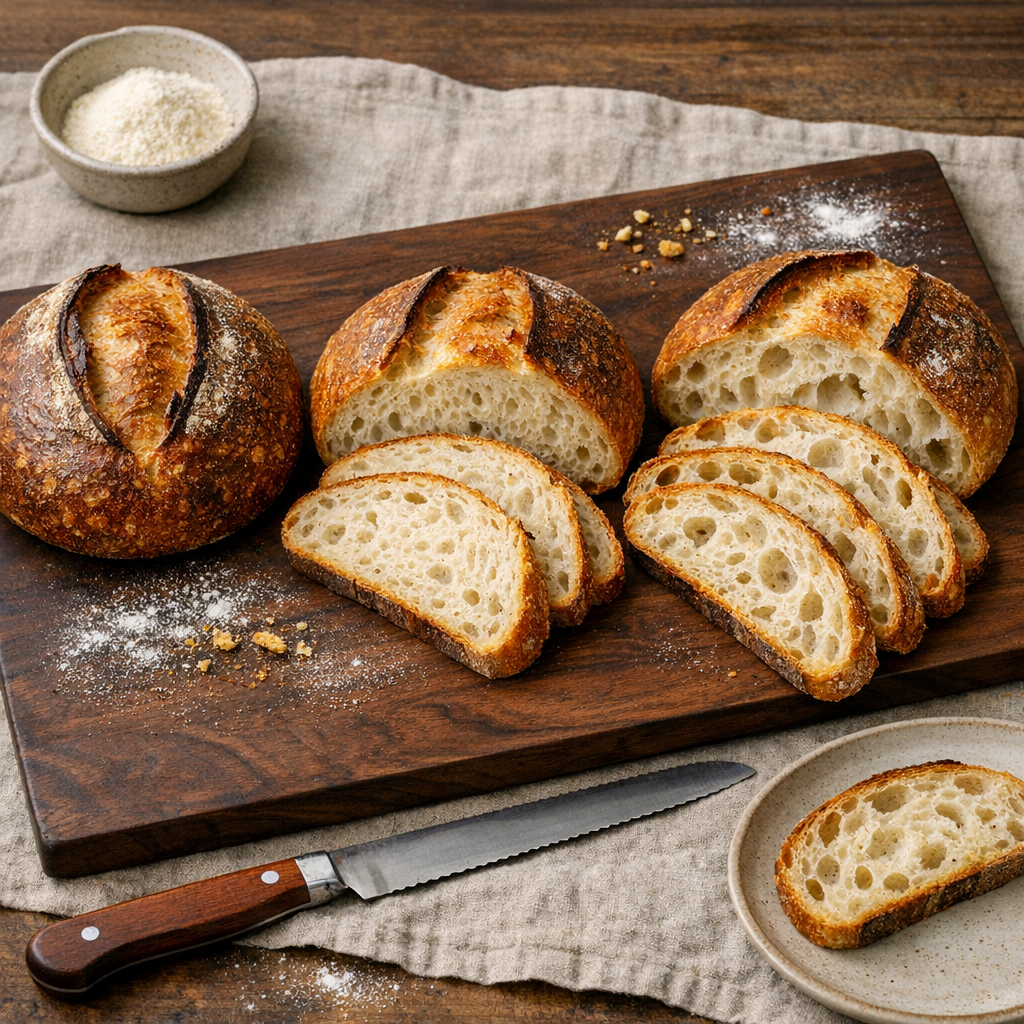
%20for%20side-by-side%20observation.%20%7C%201080%20minutes%20%E2%80%A2%203%20servings%20%23Baked%20%23Component%20%23MakeAhead%20%23recipe%20%23cooking%20%23savecooking)
Hydration is one of the most powerful variables in sourdough because water controls enzymatic activity, fermentation kinetics, and gluten extensibility. This test bake keeps flour, salt, inoculation, and temperature constant so the differences you see are largely due to water. Take notes on dough strength, rise, and crumb—this is a mini lab you can eat.
Total Time
18 hr
Prep Time
1 hr
Cook Time
2 hr
Servings
3
Ingredients
Levain (build 3–4 hours before mixing, 24–26°C / 75–79°F)
- •30 g ripe sourdough starter (100% hydration)
- •60 g bread flour
- •60 g water (room temperature)
Base dough (makes 3 small test loaves)
- •900 g bread flour (or strong white flour), divided into three 300 g portions
- •540 g water total for 65% dough (195 g) + 75% dough (225 g) + 85% dough (255 g), plus extra as needed for wetting hands
- •180 g levain (from build above), divided into three 60 g portions
- •18 g fine sea salt, divided into three 6 g portions
For baking
- •Rice flour or bread flour for dusting bannetons/towels
Instructions
- 1
Build the levain: Mix starter, flour, and water. Ferment at 24–26°C (75–79°F) until domed, bubbly, and at least doubled (typically 3–4 hours).
- 2
Set up the experiment: Label three bowls or containers as 65%, 75%, and 85%. Weigh 300 g flour into each. Weigh water into separate cups: 195 g (65%), 225 g (75%), 255 g (85%).
- 3
Autolyse (optional but recommended for consistency): Add the water for each dough to its flour and mix until no dry flour remains. Cover and rest 30 minutes at room temperature.
- 4
Add levain: Add 60 g levain to each bowl. Mix until mostly integrated (pinch-and-fold or slap-and-fold). Rest 10 minutes.
- 5
Add salt: Sprinkle 6 g salt onto each dough. Mix until fully dissolved and the dough begins to smooth. For the 85% dough, use wet hands and mix gently to avoid tearing; for the 65% dough, expect a tighter feel.
- 6
Bulk fermentation (keep all doughs at the same temperature): Ferment 3–5 hours at 24–26°C (75–79°F), performing 3 sets of folds in the first 90 minutes. Do one set every 30 minutes: for 65% use stretch-and-fold; for 75% use stretch-and-fold or coil folds; for 85% use coil folds to preserve structure.
- 7
Track fermentation: After the last fold, let the doughs rise undisturbed until they show a 40–70% volume increase and feel aerated. Expect the higher-hydration dough to ferment and relax faster. Record time to reach the same rise for each dough.
- 8
Pre-shape: Turn each dough onto a lightly floured surface. Gently pre-shape into a round. Rest 15–20 minutes uncovered.
- 9
Final shape: Shape each dough into a tight boule or small batard. Use as little flour as needed; the 85% dough may require a bench scraper and lightly wet hands. Place seam-side up in well-dusted bannetons or towel-lined bowls.
- 10
Cold proof: Cover and refrigerate all three doughs 12–16 hours at 4°C (39°F). This equalizes scheduling and makes scoring easier, especially for higher hydration.
- 11
Preheat: Place a Dutch oven (or baking stone with a covered steam setup) in the oven and preheat to 250°C (485°F) for at least 45 minutes.
- 12
Bake (one at a time): Remove one dough from the fridge, invert onto parchment, score. Bake covered 20 minutes at 250°C (485°F), then uncover and bake 15–20 minutes at 230°C (450°F) until deeply browned and the loaf feels light. Repeat for remaining doughs, reheating the Dutch oven between bakes.
- 13
Cool and evaluate: Cool at least 2 hours before slicing. Compare handling notes, spread vs. height, crust thickness, and crumb: 65% tends toward tighter, more uniform crumb; 75% balances openness and strength; 85% can be very open but is more prone to spreading if gluten development or fermentation is off.
Nutrition Facts
Per serving
* Percent Daily Values are based on a 2,000 calorie diet.
Nutrition calculated automatically from ingredients.